
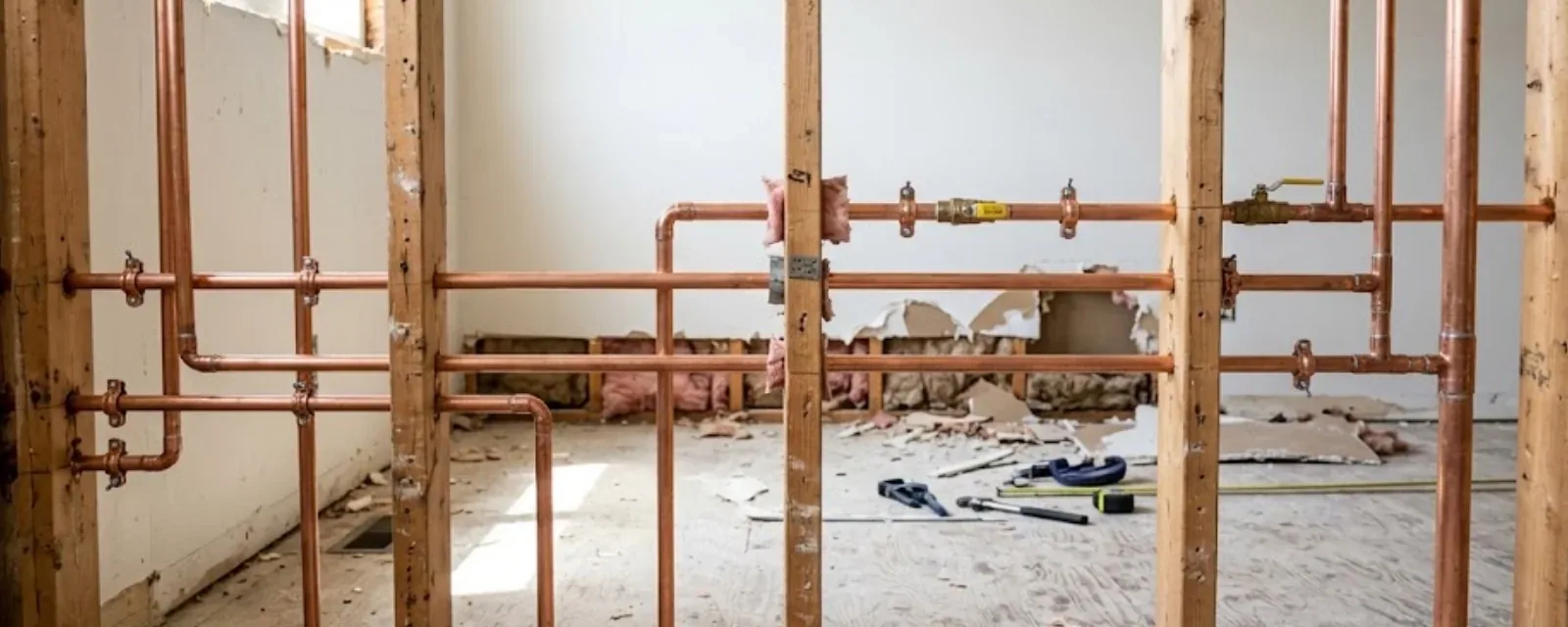
Repiping means replacing the water supply lines in your home. The new lines carry water to every faucet, shower and appliance. It is a bigger job than fixing one leak, and it makes sense when the old pipes are failing across the house. This guide explains the signs, materials and process.
Repiping does not change the drains. Those carry wastewater away and are a separate system. The supply side is the pressurized pipe that brings water in.
Signs your home may need a repipe
Warning signs
- Repeated pinhole leaks or leaks in different parts of the house.
- Brown or rust-colored water, especially after the water has been off.
- Low pressure that does not improve after cleaning aerators.
- Visible green or white crust on copper pipes, or rust on steel pipes.
- Gray plastic pipe, which may be polybutylene.
One leak does not mean the whole house needs new pipe. A plumber looks at the age, material and condition before recommending a repipe. If one section is bad and the rest is sound, a targeted fix is often the better value.
Pipe materials you might find
| Material | Common issue |
|---|---|
| Galvanized steel | Corrodes inside, narrows and restricts flow |
| Polybutylene | Known for failing at fittings, made from 1978 to the mid 1990s |
| Copper | Can develop pinhole leaks depending on water and age |
| CPVC | Can become brittle with age |
| PEX | Newer, resists corrosion, needs UV protection |
Pipe material tells you a lot about the home's age and about what could go wrong. Knowing what is inside your walls helps you plan. A plumber can often tell by looking at exposed lines in the garage, the crawlspace or near the water heater.
What the process looks like
- A plumber inspects the home, identifies the pipe and measures the layout.
- You receive a written scope and price, including permit and wall repair.
- The water is shut off for work periods, and a plan keeps fixtures usable when possible.
- New lines are run, usually through attics, crawlspaces and small wall openings.
- The system is pressure tested and inspected by the city.
- Wall openings are patched and the water is restored.
Most repipes take a few days, depending on size and access. A single-story home with attic access goes faster than a two-story home with finished walls. Ask for a timeline and what to expect each day.
Hidden costs to watch for
A repipe quote should list what is included. Check for permit fees, wall repair, painting, hauling away old pipe and fixture shutoff valves. If any of those are missing, ask whether they cost extra.
Ask whether the plan includes replacing shutoff valves and supply lines under sinks and toilets. New pipe feeding old valves leaves weak points in the system, and it costs little to replace them at the same time.
Ask about the water heater connections too. If the heater is old, it may make sense to replace it at the same visit. That saves a second round of shutting off and draining the system.
Warranties and records
Ask what the warranty covers and for how long. Ask whether it covers the pipe, the fittings and the labor, and whether it transfers if you sell the home. Keep the paperwork with your home records.
A permit and a passed inspection are part of the record. They show the work was done to code, which matters when you sell or file an insurance claim.
Alternatives to repiping
Not every failing system needs a full repipe. Partial repipes replace the worst section, such as the lines under one bathroom. Spot repairs fix a single leak. These cost less up front, but they may need to be repeated if the rest of the pipe is in poor shape.
Ask your plumber to explain where each option leaves you in five years, and let the answer guide the choice.
Yorba Linda: growth and housing age
Yorba Linda was incorporated on November 2, 1967. U.S. Census figures cited by Wikipedia show the population rising from 11,856 in 1970 to 52,422 in 1990, so a large share of the city's homes were built in the 1970s and 1980s. Polybutylene was manufactured from 1978 to the mid 1990s, so some homes from the end of that growth period may contain it. Identify your pipe before you assume anything.
Municipal Code 15.24 adopts the 2025 California Plumbing Code and sets a minimum 1 inch building supply for single-family homes in section 15.24.030. Ask the Building Division at 714-961-7120 about permits before a repipe begins.
Sources: Wikipedia citing U.S. Census figures, InterNACHI polybutylene guidance, City of Yorba Linda Municipal Code 15.24.
Repipe or repair
A repair fixes the leak you have. A repipe replaces the pipe that will leak next. Add up the repair costs of the last few years, and consider the water damage and the disruption. If the pipe is failing everywhere, a repipe is the more reliable choice.
If you are not sure whether the leak is in the pipe or somewhere else, leak detection can pinpoint it. If the failing line is the one from the street to the house, see water line repair.
Choosing a plumber for the job
Ask for the material, the fittings, the warranty and what is included. Ask who pulls the permit and who patches the walls. A good quote lists each item so you can compare it with another. Our repiping page describes how we scope a job.
Check any plumber's license at the Contractors State License Board website, cslb.ca.gov, where you can look up a license by number, business name or personnel name. Homeowners in Placentia can reach us through our Placentia page.
Frequently asked questions
It means replacing the water supply lines throughout the home. The drain lines are not part of it.
It is often gray, and it was made from 1978 to the mid 1990s. A plumber can identify it from exposed sections.
A typical home takes a few days, depending on size, access and materials.
Normally yes. Ask the Building Division at 714-961-7120 before work starts.
It can. Yorba Linda's population grew from 11,856 in 1970 to 52,422 in 1990, and some of those homes may have the pipe materials made during that era. A plumber can check yours.
For the full process and scope, see repiping.
If you only need to find a hidden leak first, leak detection helps.
For code questions, plumbing work in Yorba Linda follows the California Plumbing Code, which incorporates the Uniform Plumbing Code (UPC), and the city adopts it in Municipal Code 15.24.
Our home base and main service area is Yorba Linda, described on the Yorba Linda Pro Plumbing home page.