
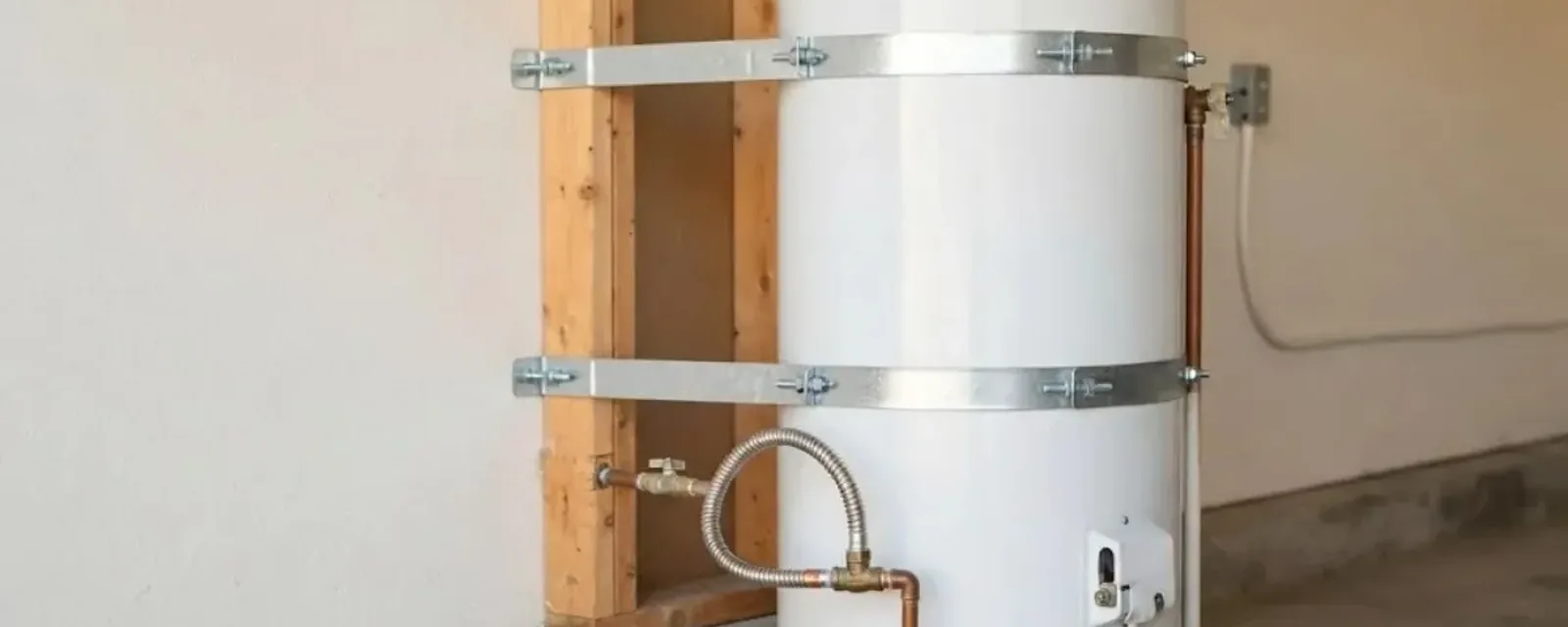
California law requires residential water heaters to be braced, anchored or strapped so they do not fall during an earthquake. A tank that tips can break gas, water and electrical connections, start a fire and flood the room. This guide explains the rule and how strapping is done.
Strapping is inexpensive compared with the damage it prevents. It is also something a plumber checks during any water heater visit.
What the law says
California Health and Safety Code section 19211 requires that all new and replacement residential water heaters be braced, anchored or strapped to resist falling or horizontal displacement due to earthquake motions. It applies to units up to 120 gallons. The code also requires sellers of homes to certify that a water heater meets the requirement.
So strapping is not just advice. It is part of the sale process and part of a proper installation. If you are buying or selling a home, check the water heater straps.
How a heater is strapped
Two metal straps wrap around the tank, one in the upper third and one in the lower third. The lower strap sits at least a few inches above the controls. The straps are fastened to wall studs with lag screws. Some installations use a kit made for the purpose.
The straps should be snug against the tank with no slack. If the heater stands away from the wall, a plumber may add blocking or use extra hardware so the straps hold firmly. Flexible gas and water connectors give extra play during shaking.
| Item | What to check |
|---|---|
| Two straps | One in the upper third, one in the lower third |
| Fasteners | Lag screws into studs, not just drywall |
| Snug fit | No slack in the straps |
| Flexible connectors | On gas and water lines |
| Clearances | Controls and vents are not blocked |
Why it matters
A full water heater is heavy. If it falls, it can rip out the gas line. Gas leaks and an open flame are a fire risk. A ruptured water line can flood a garage or closet. Straps keep the tank upright so the connections stay intact.
Most heaters in garages and closets can be strapped in a short visit. If the tank is on a platform, or the wall studs are hard to reach, it takes longer. A plumber can tell you what your layout needs.
Checking your own heater
Look at the heater. You should see two metal straps wrapped around the tank, screwed into the wall studs behind it. If you see none, or only one, or the straps are loose, the heater is not properly secured.
Push gently on the tank. A well-strapped heater does not wobble. If it does, tighten the straps or add blocking. If the heater stands away from the wall, a plumber may need to add framing so the straps have something solid to hold.
Check the flexible connectors on the gas and water lines. They should have some slack so the heater can move a little without breaking the connection. If the pipes are rigid, ask a plumber about flexible connectors.
Strapping in rentals and sales
Landlords and sellers should check their water heaters. A seller is asked to confirm that the heater meets the bracing rule, and a missing strap is easy to fix before a buyer's inspector finds it.
Tenants who see a loose or missing strap can tell the landlord in writing. The fix is quick and inexpensive.
Other earthquake steps for the home
Know where the main water and gas shutoffs are and keep the tool you need nearby. Keep a few days of drinking water on hand.
If a quake shakes the house hard, check the heater, the gas lines and the water lines. Call a plumber if you see damage.
Yorba Linda: what to check
The strapping rule comes from California Health and Safety Code section 19211. It applies statewide, so it covers water heaters in Yorba Linda homes. Yorba Linda Municipal Code 15.24 adopts the 2025 California Plumbing Code for installation work.
If your heater is being replaced, the new unit must be strapped, and a permit may be required. Ask the Building Division at 714-961-7120 what applies. Yorba Linda Water District reports groundwater hardness near 20 grains per gallon in its 2024 data, so a heater here also needs a periodic flush.
Sources: California Health and Safety Code section 19211, City of Yorba Linda Municipal Code 15.24, Yorba Linda Water District 2024 water quality data.
What to do after an earthquake
- If you smell gas, leave the house and call SoCalGas at 1-800-427-2200 or 911 from outside.
- Check the water heater and the connections for leaks or movement.
- Shut off the gas to the heater if you see damage and it is safe to do so.
- Close the main water valve if there is a leak.
- Call a plumber to inspect the heater before you use it again.
A heater that shifted but did not fall may still have damaged connectors. Do not relight it until a plumber has checked it. Our water heater repair visit includes inspection of the connections and the relief valve.
When to replace the heater
If the heater is old, rusted or leaking, strapping will not fix it. A new unit comes with proper installation, new flexible connectors and straps. See water heater replacement for what that includes.
Ask your plumber to check the straps whenever they are on site. For homes near Placentia, see the Placentia page for coverage.
Frequently asked questions
Yes. California Health and Safety Code section 19211 requires residential water heaters to be braced, anchored or strapped.
Two are typical, one in the upper third and one in the lower third of the tank.
The requirement applies to storage tank water heaters. Tankless units are mounted on the wall, and the manufacturer's instructions govern.
California law requires sellers to certify that the water heater meets the bracing requirement. Check the straps before listing.
Shut off the gas to the heater if it is safe, close the water if there is a leak and call a plumber before using it again.
For inspection and service, see water heater repair.
If the tank is at the end of its life, water heater replacement includes strapping.
For code questions, plumbing work in Yorba Linda follows the California Plumbing Code, which incorporates the Uniform Plumbing Code (UPC), and the city adopts it in Municipal Code 15.24.
Our home base and main service area is Yorba Linda, described on the Yorba Linda Pro Plumbing home page.