
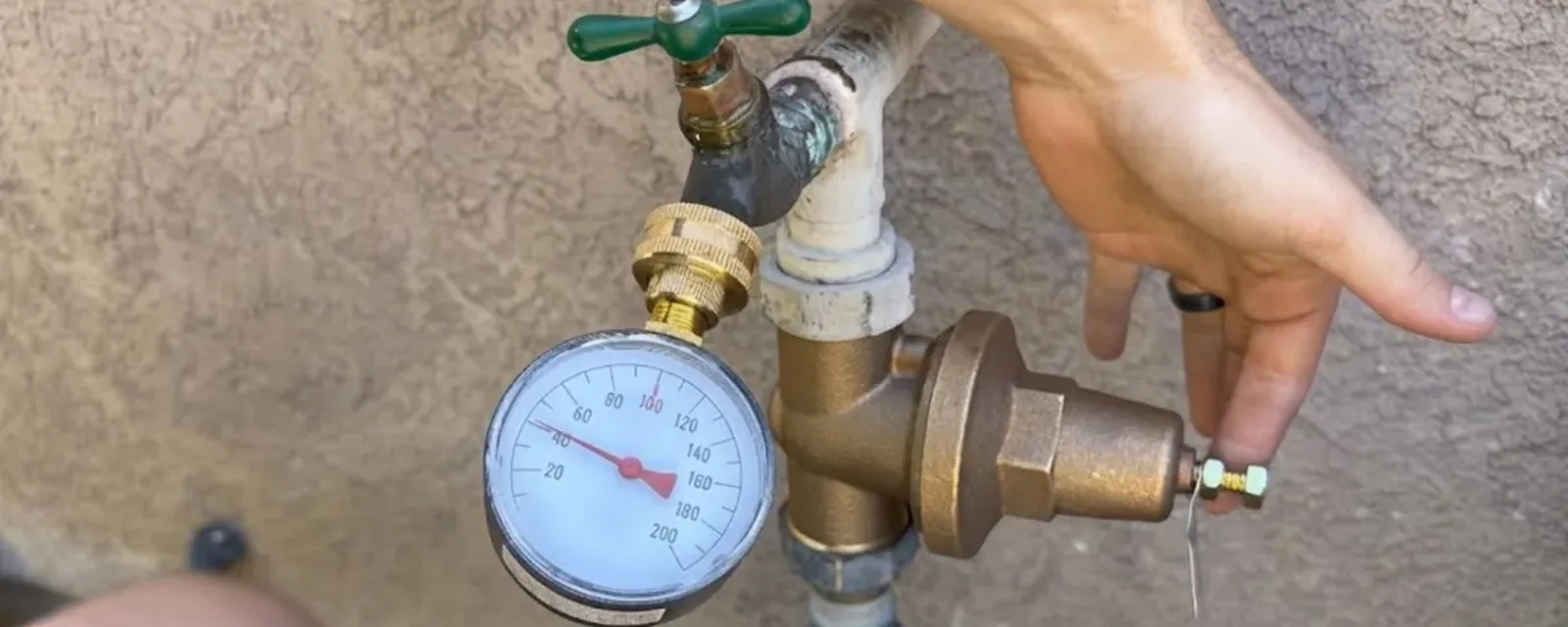
Strong pressure feels good in the shower, but too much of it wears out pipes, water heaters, toilets and washing machine hoses. A pressure regulator holds the pressure at a safe level. This guide explains how to test your pressure, what a regulator does and when to replace one.
Signs of high pressure include banging pipes, a relief valve that drips, faucets that spit and fixtures that wear out early. A simple gauge tells you the actual number, so you do not have to guess.
How to test your pressure
- Buy a water pressure gauge that screws onto a hose bib, which is inexpensive at hardware stores.
- Make sure no water is running in the house, including the ice maker and the irrigation.
- Screw the gauge onto an outdoor hose bib and open the valve fully.
- Read the pressure, which is the static pressure.
- Check again at night or early morning, since pressure can be higher when demand is low.
The California Plumbing Code, in section 608.2, calls for a pressure regulator with a strainer when static pressure is above 80 psi. A reading over that line means a regulator is required, and a reading well below it suggests a different problem.
What a pressure regulator does
A regulator is a brass valve on the main water line, usually near the shutoff. A spring and a diaphragm inside reduce the incoming pressure to a set value. The valve has an adjustment screw to fine tune it.
Over time the spring weakens, the diaphragm tears and debris clogs the strainer. A failed regulator can let full street pressure into the house or restrict flow so much that showers weaken. Regulators typically last many years, but they are not permanent.
| Static pressure | What it suggests |
|---|---|
| Below about 40 psi | Low pressure, check for a clogged line or regulator |
| About 40 to 80 psi | Acceptable range for most homes |
| Above 80 psi | Regulator required by code, damage risk |
| Rising overnight | Failing regulator or a thermal expansion issue |
Thermal expansion and relief valves
When a regulator or a check valve blocks water from flowing back to the street, heating water in the tank has nowhere to go. Pressure climbs and the relief valve on the heater may drip. An expansion tank on the cold supply gives the water somewhere to expand.
A dripping relief valve on a water heater is a warning. If it drips often, test the pressure and the expansion tank before you replace the valve. See water heater repair for a full check of the heater and its safety parts.
Setting the regulator
Most regulators come set at a factory value. A plumber adjusts the screw while watching a gauge, and then leaves the pressure in a range that works for your fixtures without straining them. Many homeowners find a moderate setting works well.
Do not set the pressure by feel. The shower may feel weak at a lower setting even though the number is healthy, and a gauge keeps you from raising the pressure too far. Check the gauge again after a few days, since a new regulator can creep.
If the pressure keeps rising after the regulator is set, the regulator is failing or thermal expansion is pushing it up. Both need a plumber.
Hoses and appliances
Washing machine hoses and ice maker lines are early victims of high pressure. A burst hose can flood a laundry room in minutes. Braided hoses and shutoff valves help, but the real fix is the pressure.
Turn off the washer valves when you leave on a trip. It takes a few seconds and removes a common cause of water damage.
Yorba Linda: elevation and pressure
Yorba Linda Water District reports that its service area ranges in elevation from about 250 feet to over 1,390 feet, and the district runs about 355 miles of water mains and 14 reservoirs. Water pressure in a hilly service area varies with elevation, so two homes in the same city can have very different static pressure.
That is why testing your own pressure matters. Municipal Code 15.24 adopts the California Plumbing Code, whose section 608.2 requires a regulator with a strainer above 80 psi. Ask the Building Division at 714-961-7120 if you are unsure what permit applies to a regulator replacement.
Sources: Yorba Linda Water District, California Plumbing Code section 608.2, City of Yorba Linda Municipal Code 15.24.
Replacing a pressure regulator
A plumber shuts off the main, drains the line, removes the old regulator and installs a new one with unions so it can be serviced later. The new valve is adjusted to a safe setting and checked with a gauge. The job is often completed in a single visit.
Ask the plumber to check the main shutoff at the same time. If the shutoff valve is old and does not close, replace it while the line is open. See water line repair if the line leading to the regulator has problems.
Protect your fixtures
Signs to act on
- Banging or hammering pipes when a valve closes.
- A water heater relief valve that drips.
- Toilets that fill noisily or run on.
- Washing machine or dishwasher hoses that burst or bulge.
- A gauge reading above 80 psi.
If pressure is high at a single tap and low at others, the issue may be local. A clogged aerator or a stuck cartridge produces odd results. Hard water scale is common here, so a faucet repair may fix a single fixture.
Placentia homes on the western side of our area follow the same code. See the Placentia page for our coverage there.
Frequently asked questions
Many homes run between 40 and 80 psi. The California Plumbing Code calls for a regulator when static pressure exceeds 80 psi.
Signs include pressure above 80 psi on a gauge, banging pipes, a dripping relief valve and fixtures that wear out early.
Yes. High pressure strains the tank, the relief valve and the fittings. An expansion tank can help with thermal expansion.
It can. Yorba Linda Water District reports elevations from about 250 to over 1,390 feet in its service area, so pressure depends on where your home sits.
Ask the City of Yorba Linda Building Division at 714-961-7120. Requirements depend on the scope of work.
For a leaking relief valve or tank, see water heater repair.
If pressure problems come from the line itself, water line repair covers the service line.
For code questions, plumbing work in Yorba Linda follows the California Plumbing Code, which incorporates the Uniform Plumbing Code (UPC), and the city adopts it in Municipal Code 15.24.
Our home base and main service area is Yorba Linda, described on the Yorba Linda Pro Plumbing home page.