
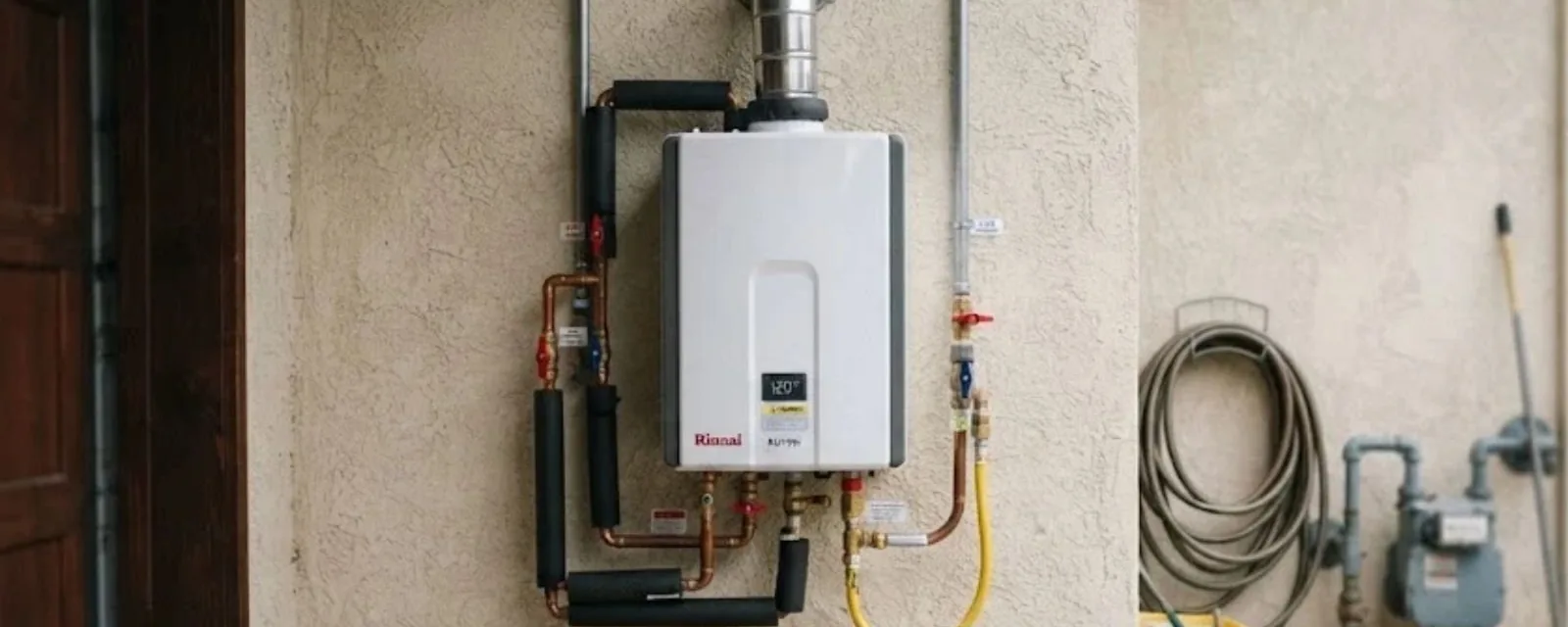
A direct vent tankless water heater pulls combustion air from outside and sends exhaust back out through sealed pipe. Because the burner is closed off from the room, it can be installed in tighter spaces than an older atmospheric unit. This guide explains how it works, what venting involves and what to ask before you buy.
Tankless units heat water on demand instead of storing it, so there is no tank to leak. They need the right gas supply, a vent run that meets the manufacturer's rules and a drain path for condensate on some models. Getting those three right is most of the job.
What direct vent means
In a direct vent unit, the combustion chamber is sealed. Outside air comes in through one pipe or one side of a coaxial pipe, and exhaust leaves through another. The room air is not used for burning gas. That keeps the heater from competing with other appliances for air and reduces the chance of exhaust backing into the home.
Power vent and atmospheric units are different. A power vent unit uses a fan but still draws room air. An atmospheric unit uses a draft and room air. Check the label on your current heater before you assume a new one will use the same vent.
Vent materials and routing
Each manufacturer lists approved vent materials, maximum lengths and the number of elbows allowed. High-efficiency condensing models produce acidic condensate, so they use plastic vent pipe and need a drain. Non-condensing models run hotter and use stainless or special metal vent pipe.
Vent runs go through a wall or the roof. The termination point has clearance rules from windows, doors and air intakes. A plumber reads the installation manual for your exact model, because a vent that is too long or has too many bends will cause error codes and poor performance.
| Feature | Condensing | Non-condensing |
|---|---|---|
| Vent material | Plastic, such as PVC or CPVC where listed | Stainless or listed metal |
| Condensate drain | Required | Usually not required |
| Exhaust temperature | Lower | Higher |
| Efficiency | Higher | Lower |
| Up-front cost | Often higher | Often lower |
Gas line and power
Tankless units burn gas at a high rate for short periods. An older gas line sized for a tank heater may be too small. The installer checks the pipe size and length to confirm it can supply the new unit along with your other gas appliances. If not, the line is upsized.
Most units also need a standard electrical outlet for the controls and fan. If there is no outlet near the heater, one needs to be added.
Planning the installation
- Pick the location, ideally close to the main hot water demand and with room for vent and clearance.
- Confirm the gas pipe size, meter capacity and gas shutoff.
- Plan the vent route and the termination point against clearance rules.
- Plan the condensate drain if the unit is condensing.
- Plan water connections and add service valves for flushing.
- Confirm permit and inspection steps with the city before work begins.
Service valves matter. They let a plumber flush scale out of the heat exchanger. Without them, the unit must be shut off and disconnected to be cleaned. Most manufacturers recommend periodic flushing in hard water.
Questions to ask a contractor
Ask which model the contractor recommends and why. Ask how long the vent run will be and where it will end. A vent that ends near a window, a door or a neighbor's property can cause problems, so the plan should show the exact location.
Ask whether the gas line and meter can supply the unit. Ask about a condensate drain and a neutralizer if the model is condensing. Ask what the warranty covers and whether it requires regular flushing in hard water.
Finally, ask who handles the permit and the inspection. A complete quote lists the unit, the vent, the gas work, the electrical connection and the permit, so you can compare it with another bid on equal terms.
Yorba Linda: code and water
Yorba Linda Municipal Code 15.24 adopts the 2025 edition of the California Plumbing Code, which incorporates and amends the 2024 Uniform Plumbing Code. A tankless installation is a gas and venting job, so it is not a like-for-like permit exception. Ask the Building Division at 714-961-7120 what the city requires.
Yorba Linda Water District's 2024 data shows groundwater hardness averaging about 20 grains per gallon. Hard water builds scale on a tankless heat exchanger, which cuts flow and efficiency. Plan for flushing from the start, and consider a softener upstream.
Sources: City of Yorba Linda Municipal Code 15.24, Yorba Linda Water District 2024 water quality data.
Is direct vent the right choice for your home
It makes sense when the heater needs to go into a closet, garage corner or exterior wall where an atmospheric unit would not work. It also suits homes where a tank has leaked and the owner wants to remove the risk. It costs more up front than a tank replacement, so compare the full price including vent and gas work.
Our tankless water heater page covers service and replacement in detail, and water heater installation explains how a new unit is set up.
Homeowners in Placentia ask the same questions. Our Placentia page covers how we reach that side of the area.
Frequently asked questions
A direct vent unit draws combustion air from outside through sealed pipe. A power vent unit uses a fan but still draws air from the room.
Usually not. Tankless units have specific vent material and size rules, so the old tank vent is often replaced.
Condensing models do, because they produce acidic water. Non-condensing models usually do not.
It can. Yorba Linda Water District reports groundwater hardness near 20 grains per gallon in its 2024 data, so scale on the heat exchanger is a real issue. Regular flushing helps.
It involves gas piping and venting, so ask the City of Yorba Linda Building Division at 714-961-7120 what applies to your project.
For repair or flushing of an existing unit, see tankless water heater service.
If you are comparing against a tank, water heater replacement shows what that route involves.
For code questions, plumbing work in Yorba Linda follows the California Plumbing Code, which incorporates the Uniform Plumbing Code (UPC), and the city adopts it in Municipal Code 15.24.
Our home base and main service area is Yorba Linda, described on the Yorba Linda Pro Plumbing home page.